


Alaska Fishing Conservation Efforts | Copper River Lodge
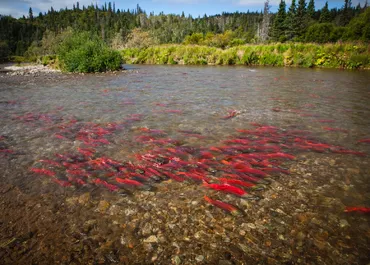
The Copper River Lodge is concerned about the salmon populations around the world, and Alaska. We are fortunate to have very stable salmon runs, but they need to be protected to keep them that way.Threats from the Pebble Mine, over fishing, and habitat destruction could all play a role in destroying one of the largest intact salmon ecosystems left in the world.
On this page we will try to keep you updated on current threats. We also donate trips every year to these conservation causes. If you are interested in bidding on a trip please let us know. We also sell $100 raffle tickets for a free trip, 100% of the donation will go to fighting the Pebble Mine, or habitat preservation through the agencies below.
Our greatest fight at this point is trying to slow down or stop Pebble Mine which could become the largest open pit mine in the world. The mine is located between the two largest salmon producing drainages in Alaska, the Nushagak and the Kvijack. Please support the agencies that are fighting this mine: Trout Unlimited, the Conservation Fund, the Nature Conservancy, and the Sportsman's Alliance.
Another major concern for Pacific Salmon has emerged this fall. Scientist have found wild Sockeye salmon with salmon anemia. This is the first time it has been found in the Pacific Northwest. It has been blamed for decimating many Atlantic salmon runs. It morphed into this deadly disease in Atlantic fish farms. It is believed that the fish farms in British Columbia Canada are the source of this new disease. IF EVER YOU WERE LOOKING FOR A REASON TO EAT WILD SALMON THIS IS IT! STOP EATING FARMED SALMON (ESPECIALLY FROM CANADA)! There is a link below for the most recent articles.
If you would like to see a great video on the mine please watch this video , Red Gold.
Recent News:
Update for 2017/2018:
As you might have heard Scott Pruitt of the EPA has slowed our progress to a standstill, and threatens to erase our years of hard work. A permit application from Pebble Partnership will most likely be occurring.For the most up to date information on the Pebble Mine please go to:
Savebristolbay.org
Bristol Bay needs every sportsman and woman that has fished, or wants to fish, Bristol Bay to make a donation this summer! We cannot let these generous donations and matches go unfulfilled and, most importantly, we cannot allow foreign mining companies to devastate the world’s greatest Sockeye run. Bristol Bay’s fish, wildlife, and people are depending on us to support them.
If you want to make a donation please click on this link, every donation helps! https://gifts.tumembership.org/donate/sbb-sportsmens-challenge
| IF YOU WANT YOUR DONATION QUADRUPLED YOU HAVE TO MENTION SWEETWATER TRAVEL, COPPER RIVER LODGE, OR ROYAL COACHMAN LODGE, IN THE MEMO OF YOUR DONATION. |
www.savebristolbay.org
Thank you for your support!
The Year in Review December 18, 2012
by Shoren BrownAs 2012 comes to a close, we bring you a brief year in review.
This has been a momentous year for Bristol Bay. In May, the EPA released its 338-page Bristol Bay Watershed Assessment, examining the impacts of large-scale mining to the region’s clean waters and fisheries. The report found that even without multiple spills or a disaster, digging up the Pebble deposit would destroy up to 87 miles of salmon bearing streams and up to 4,300 acres of salmon wetland habitat. The agency followed up with a series of eight hearings, including six in the region, all featuring strong turnout and impassioned testimony. In total, more than 2,200 people attended the hearings, and more than 80 percent expressed opposition to Pebble mine and support for the EPA’s report. Support in the region was even higher at 93+%.
The EPA then conducted a scientific peer review of its report by 12 outside experts selected by an independent contractor. Many of the panelists found that EPA underestimated the risks of the Pebble project, including tailings dam failure, and operational leaks and spills. Their comments are being incorporated into the Assessment, as are the public comments submitted by more than 150,000 groups and individuals. The report is expected to be finalized in the first few months of 2013.
Fishermen and groups across the country banded together in the Commercial Fishermen for Bristol Bay network, garnering support across the country for protection of Bristol Bay's fishing jobs and industry. More than 850 hunting, fishing and outdoors groups from across the country sent a letter to President Obama urging protection of Bristol Bay.
In addition, Anglo American – the bigger of the Pebble mine backers – experienced a tumultuous year of strikes, labor unrest and violence at its South African platinum and gold mines, eventually leading to the resignation of its CEO.
The coalition to protect Bristol Bay continues to grow nationally and in Alaska, and is pushing Congress and the Administration to support action under section 404c of the Clean Water Act, to protect Bristol Bay, one of most productive, economically beneficial waters in the United States.
Shoren Brown is Bristol Bay Campaign Director for Trout Unlimited.
Expires November 1, 2012!
Help us save the Bristol Bay Salmon from the now infamous Pebble Mine. If you make a donation now to Trout Unlimited to fight the Pebble Mine we will triple it!After returning from a recent trip to Washington, DC to generate political opposition to the Pebble Mine, it is clear to us that the fight to oppose the Pebble Mine must go national and that this fight requires money. At Sweetwater Travel, the Royal Coachman Lodge, and the Copper River Lodge, we are challenging fishermen and women from around the world to help us save one of the last wild Sockeye Salmon runs in the world (actually 46% of the world’s wild Sockeye salmon run into Bristol Bay, Alaska). We cannot allow this resource to be threatened or compromised by one company’s pursuit of gold and copper. The communities of Bristol Bay along with future generations of fishermen and women are counting on all of us to save this priceless resource.
An anonymous foundation has made a very generous donation to help fight Pebble Mine. Additionally, they will match all donations made to Trout Unlimited to fight the Pebble Mine up to $200,000! In addition we have also received a generous challenge grant from the George and Paula Hauer Foundation for $5,000. Finally, to demonstrate our support for the fight to stop the Pebble Mine, the Copper River Lodge, and the Royal Coachman Lodge, and Sweetwater Travel will also match the first $5,000 donated to TU.
All of the matches will expire next fall. In the meantime, if you make a donation to Trout Unlimited to fight the Pebble Mine, it will be tripled (for the first $10,000 raised). Bristol Bay needs every sportsman and woman that has fished, or wants to fish, Bristol Bay to make a donation this summer! We cannot let these generous donations go unfulfilled and, most importantly, we cannot allow foreign mining companies to devastate the world’s greatest Sockeye run. Bristol Bay’s fish, wildlife, and people are depending on us to support them.
If you want to make a donation please click on this link, every donation helps! IF YOU WANT YOUR DONATION MATCHED YOU HAVE TO MENTION SWEETWATER TRAVEL, COPPER RIVER LODGE, OR ROYAL COACHMAN LODGE, IN THE MEMO OF YOUR DONATION.
savebristolbay.org/challenge
If you want to learn more on why this is the wrong mine in the wrong place please click here….
www.savebristolbay.org
Thank you for your support!
 Feb 7, 2012:
New scientific report describes dangers of Pebble Mine to Bristol Bay salmon, watershed and communities;
Concludes Pebble is a monumental gamble that risks too much
Portland, Ore. – The proposed Pebble Mine would siphon as much as 35 billion gallons of fresh water out of the headwaters of Bristol Bay, Alaska every year, eliminating critical salmon habitat, and would likely facilitate the development of a much larger mining district, further endangering the world’s largest wild sockeye salmon fishery, according to a new, comprehensive report.